What are the social
determinants of health?
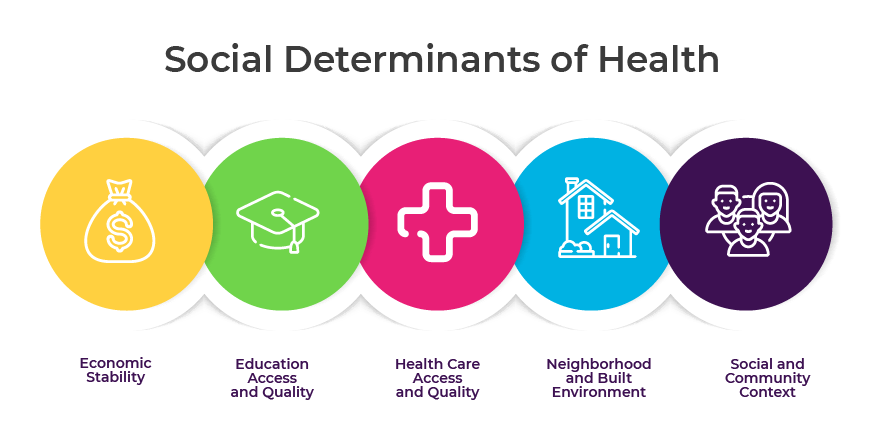
Social determinants of health are the non-medical factors that influence health outcomes and health inequities (Glenn et al., 2024). These factors include access to health care, education, environment, social support, and economic stability (Glenn et al., 2024). Not only do social determinants of health exist at an individual level, but also on a community level.
Why are
they important?
I
never learned about the social determinants of health in my undergraduate
schooling. The focus of education was
geared more towards treating a patient’s medical condition and diagnosis as opposed
to their non-medical factors. I became
more aware of the social determinants of health as I practiced as a registered
nurse. Caring for my patients on the front line showed me how the variety of different
environments, education levels, and social supports affect the health of my
patients. I started to see patterns such
as uncontrolled diabetes or hypertension in my homeless diabetic patients or increased
exacerbations in my chronic obstructive pulmonary disease (COPD) patients who either
smoke or are exposed to secondhand smoke.
It was clear that their environments were directly affecting their health. If healthcare professionals do not try to
resolve the factors involved with social determinants of health, they will
continue to treat the negative effects of these factors repeatedly. This increases healthcare costs, leads to
crowded emergency departments, and increases healthcare provider burnout (Glenn
et al., 2024).
Responsibility of healthcare professionals?

I believe that healthcare professionals must screen for any issues with their patient’s social determinants of health because of their strong effect on patient health outcomes. However, I will admit that the job is easier said than done. Many offices are utilizing screening tools to assess limitations in social determinants of health and recording data so that it can be used to assess the needs of the community (Glenn et al., 2024). I do believe other disciplines such as social work or case managers can assist the provider in discussing resources and community assistance programs once a provider identifies a need, but I do not agree that this job solely belongs to outside disciplines.
A study by Glenn et al. (2024) shows that providers believe the social determinants of health affect their patients but feel as though their healthcare organizations limit their ability to appropriately address their needs. Many barriers exist in the screening of the determinants of health including time (Glenn et al., 2024). Providers feel as though they don’t have adequate time in their scheduled appointments to discuss a patient’s non-clinical needs (Glenn et al., 2024). Time seems nonexistent in healthcare right now. Not only are patients waiting extensive amounts of time to receive an appointment time, but once they arrive, they often are rushed in and out because of the provider’s heavy schedules. I currently work in an inpatient hospital setting. I often see providers poke their heads in and out of a patient room in less than one minute for their “visit” of the day. How can a patient even have the time to bring up an issue like food insecurity or lack of funds to pick up their prescription when the provider sees them for sixty seconds?
Providers must inform their organizations of the barriers they may face to adequately screen and identify needs in a patient’s social determinants of health. Healthcare professionals need to be educated in their schooling about the importance of identifying patient’s needs and how the determinants of health affect health outcomes. Healthcare providers need to collaborate with community-based organizations and advocate for health policy and system changes to dig into the causes of needs in social determinants of health.

Barriers
to acceptance
How many healthcare professionals reading
this blog have spent most of their shift addressing a need a patient may have
for them to decline the help? I remember
working closely with discharge planners to find a transitional bed for a
homeless patient. They declined the help
and left the hospital the same way they arrived…homeless. It is hard to accept. I wanted to yell “FINE, see you back here in a
few days!” But of course, I couldn’t.

A study done by Pfeiffer et al. (2022)
proves that patients decline assistance because of the stigma that their
community associates with accepting help.
Many patients feel embarrassed to admit they need help and feel as
though they are failing their families (Pfeiffer et al., 2022). Providers need
to understand that patients may feel ashamed to accept help. It may even take a handful of appointments
and discussions before a patient accepts assistance. Establishing a trusting relationship with a
patient takes time. Healthcare
professionals must remain non-judgmental to help promote honesty and compliance
with their patients. I know this is also
easier said than done!
References
Glenn, J., Kleinhenz, G., Jenna M., Smith,
R., Victor B.A., Donoso, P. G., Stone, S., Hanson, C. L., Redelfs, A. H., &
M. Lelinneth. (2024). Do healthcare providers consider the social determinants
of health? Results from a nationwide cross-sectional study in the United
States. BMC Health Services Research, 24(1). https://doi.org/10.1186/s12913-024-10656-2
Pfeiffer, E. J., De Paula, C. L., Flores,
W. O., & Lavallee, A. J. (2022). Barriers to patients’ acceptance of social
care interventions in clinic settings. American Journal of Preventive Medicine, 63(3), S116–S121. https://doi.org/10.1016/j.amepre.2022.03.035
